taekwondo competition

Many people have asked me to talk about my hobbit that is taekwondo. so in the blog we spoke from the competitions until the history of taekwondo over years
The competions approved by the assembly on request of the territorial, these competitions are scored. To climb positions in the ranking. RFET.

Júnior World championship
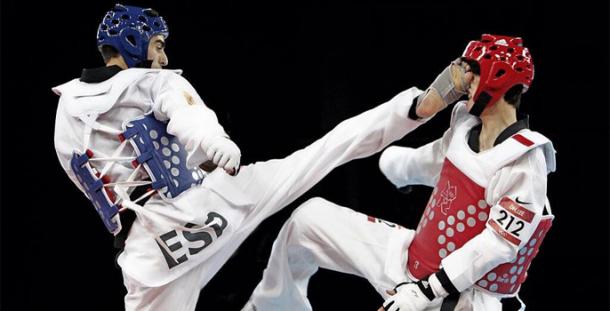
Taekwondo competitions typically involves sparring, breaking, and patterns.
Some tournaments also incluye especial eventos such as demostration teams and self-defense
the equipment that is used to complete in taekwondo is:
body protector; foream protector; fighter gloves; head protector; pro mouth guard; shin pads; taekwondo food protector
taekwondo levels or belts
white: a test is not required for the white belt, but in order to move on the next rank, one first has to aschive the white belt with yellow shipes
yellow: the color yellow indicates that the person is getting to know the basic tecniques,this stadium is compared to a plant growing its roots
green: the color green indicates that a student is growing as a taekwondo student. the color of the belt is compared to a plant growing its leafs
blue: the color blue indicates that a student is reaching higher, like a plant that is growing towards the sky
red: the color red indicates danger. student is warned to practice the control of his/her movements. the color red also warns an opponent
poom (black red belt): taekwondo requires that one has to be 16 year old to get a black belt. if younger, you get a poom
black(1st dan): black is opposite of white and means the maturity of student in the art. its also indication if being impenetrable for fear and darkness

Some tournaments also incluye especial eventos such as demostration teams and self-defense
the equipment that is used to complete in taekwondo is:
body protector; foream protector; fighter gloves; head protector; pro mouth guard; shin pads; taekwondo food protector
 |
taekwondo levels or belts
the range of coloured belts can be confusing for someone who is new to the sport. here are the most common colours and the ranks correspond to:
white: a test is not required for the white belt, but in order to move on the next rank, one first has to aschive the white belt with yellow shipes
yellow: the color yellow indicates that the person is getting to know the basic tecniques,this stadium is compared to a plant growing its roots
green: the color green indicates that a student is growing as a taekwondo student. the color of the belt is compared to a plant growing its leafs
blue: the color blue indicates that a student is reaching higher, like a plant that is growing towards the sky
red: the color red indicates danger. student is warned to practice the control of his/her movements. the color red also warns an opponent
poom (black red belt): taekwondo requires that one has to be 16 year old to get a black belt. if younger, you get a poom
black(1st dan): black is opposite of white and means the maturity of student in the art. its also indication if being impenetrable for fear and darkness
taekwondo definition:
Taekwondo is best known for its use of kicks. This
makes it different from other martial arts such as karate or certain forms of
southern kung-fu. Kicking is important because the leg is the most powerful and
longest body part that the martial artist can use as a weapon. Therefore, a
fighter who kicks well can hurt his opponent without hurting himself.
One of the most important exercises is the act of
doing poomse (katas in terminology of karate). The poomses and the control of the
different movements.
Taekwondo as a sport and as an exercise is popular
among people of both sexes and many ages. Taekwondo develops force, speed,
balance, flexibility, and stamina. It also involves mental focus. Breaking
boards, for example, demonstrates a union of mental and physical discipline.
Breaking a board with one's hand or foot requires both the physical mastery of
the technique and a concentrated focus on one's force. are the arranged groups
of movements of defense and of attack. They simulate a combat against diverse
adversaries, and they are related directly to the different degrees of belts.
They are done with the purpose to improve the equilibrium, the elasticity, the
rapidity

history of taekwondo:


Even though some things
in Tae Kwon Do have changed over the years, respect is not one of those things.
Respect is the biggest part of Tae Kwon Do, without respect Tae Kwon Do would
not be the huge art it is today. Some of the things that have changed are the
belts. The original colors are still the same, but every time you test you
either receive a new belt or receive a stripe to place on you current belt.
Legend has it that long ago there was just one belt.[2] There still were colors though:
white, the color the belt was originally; yellow, the color achieved thorough
sweat soaking into the belt; green, a color that came though practicing outside
and falling; blue, the color of the sky; red, the color of blood; and black,
the color of all the dirt mixing with everything else on the belt.
Therefore, the word "Taekwondo" could be translated as
"The path of feet and hands", a name that refers to a combat style
that makes use of the legs, fists and other parts of the body, regardless of
the weapons .
Taekwondo is a modern
martial art (1955) of Korean origin created by General Choi Hong Hi. It became
part of Olympic sports in 1988 at the Olympic Games in Seoul
Taekwondo is based on
much older martial arts, such as Chinese kung fu or wu shu, and in some of its
techniques, such as open-hand techniques, it is based on Korean taekkyon,
Japanese karate-do (Shudokan styles) and Shotokan). where the blows come from
the fist.
The Korean masters, a
consequence of their strong nationalism and resentment for the Japanese
occupation (1910-1945) and the Korean War (1950-1953), locate the birth of
taekwondo in 50 AD, with the practice of the native martial art called taekkyon

Comentaris
Publica un comentari a l'entrada